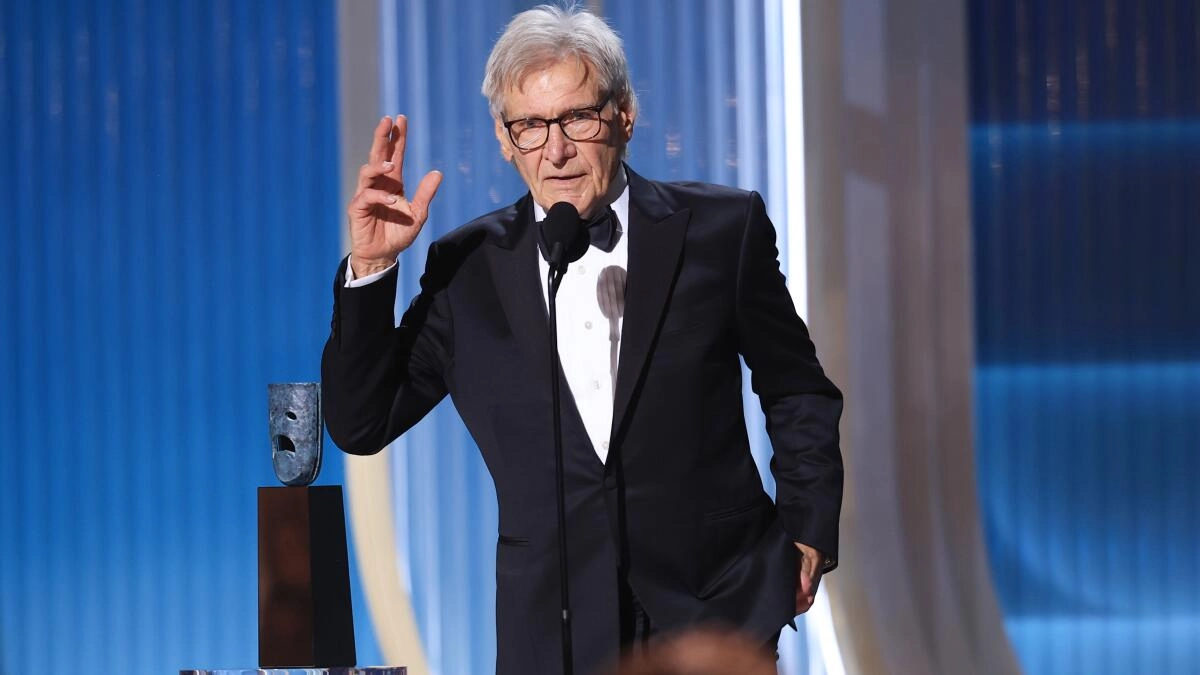
Sunday night in Los Angeles, Harrison Ford stood up to accept the SAG-AFTRA Life Achievement Award — the highest honor that actors give to one of their own. He looked out at the room. Took a breath. And said:
“It’s a little early, isn’t it?”
The audience laughed. But Ford wasn’t done. “It’s a little weird to be getting a lifetime achievement award at the half-point of my career.”
He’s 83 years old. He just wrapped a Marvel movie. He just received his first-ever Emmy nomination. He is still filming Shrinking on Apple TV+. And he meant every word of that joke.
What happened Sunday wasn’t just a feel-good awards moment. It was Harrison Ford, in two sentences, telling you exactly who he is.
The Career That Never Had a Script
Most actors who reach Ford’s level follow a path you can map. Big movies. Awards push. Legacy roles. Slow down. Then lifetime achievement.
Harrison Ford never did any of that on purpose.
He was a carpenter in 1977 when Star Wars happened. George Lucas needed someone to read lines opposite actors auditioning for American Graffiti — and Ford was there, fixing the cabinets. He got the part of Han Solo almost by accident. He’s said as much himself, more than once.
But here’s the common thread worth paying attention to: Ford has always picked roles that surprised people.
Han Solo was a roguish space smuggler with a sarcastic smile — not what 1970s Hollywood expected from a leading man. Indiana Jones was a soft-spoken professor who ran from boulders on weekends. A joke with muscles. Jack Ryan was a desk analyst with no business being in the field. And now, in his eighties, Ford plays a grief-stricken therapist in a comedy while also suiting up as U.S. Secretary of State — and then President — in the Marvel Cinematic Universe.
The pattern isn’t genre. It’s not even range, in the traditional sense. It’s Ford’s refusal to become a type.
Most stars of his generation got comfortable somewhere and stayed. Ford kept moving. And what’s striking, looking back, is that each unexpected move worked — not always at the box office, but always on screen.
What Shrinking Actually Shows
The most interesting thing Ford has done in years isn’t Indiana Jones. It’s Shrinking.
The Apple TV+ show, which began in 2023, casts Ford as Dr. Paul Rhoades — a senior therapist who has been told he has Parkinson’s disease. The role doesn’t ask for stunts or swagger. It asks for something Harrison Ford has spent fifty years quietly hiding behind the adventure: stillness.
And he is genuinely, surprisingly good at it.
His Emmy nomination last year — his first in a career spanning seven decades — was earned, not given. He plays Paul with a dry, almost reluctant warmth. The guy in the room who knows the most but says the least. It’s the kind of performance that grabs you while you’re watching but gets overlooked at ceremony time. That’s very Harrison Ford.
What strikes me most about Shrinking is what it reveals about what Harrison Ford has been doing all along: playing people who project strength while quietly carrying something heavy. Han Solo’s cockiness covered real fear. Jack Ryan’s calm covered panic. Rick Deckard’s detachment covered exhaustion. And now Paul Rhoades’s dry humor covers grief and a diagnosis he hasn’t fully come to terms with.
The mask changes. The man underneath doesn’t.
The Film Nobody Wants to Talk About
Ask most people to name Harrison Ford’s greatest film. They’ll say Star Wars. Maybe Raiders of the Lost Ark. Some will say The Fugitive — that 1993 chase film he made between franchise entries, the one many critics still consider his most complete performance as a purely human character under pressure.
Very few people mention Blade Runner.
The 1982 sci-fi film was a box office letdown when it came out. Critics were split. Audiences weren’t sure what they were watching. Ford himself has never been easy about the film — he and director Ridley Scott clashed repeatedly on set, and Harrison Ford was open about it for years.
And yet Blade Runner became one of the most studied, talked-about films in cinema history. Whole books have been written about it. Film schools teach it. Directors cite it.
Harrison Ford showed up to its 2017 sequel, Blade Runner 2049, with zero obligation to return — he’d made his feelings about the original clear — and delivered one of his most careful, quietly emotional performances. He didn’t have to be there. He came back anyway.
That tells you something. Whether it’s stubbornness or loyalty or just curiosity — who knows. But the results keep arriving.
The Numbers Behind the Modesty
Here’s the part that doesn’t fit the modest, reluctant-actor story Harrison Ford likes to tell about himself.
Harrison Ford has never won a competitive acting Oscar. He has one Emmy nomination — from last year. He has never been seen as a craft-first performer in the way that Daniel Day-Lewis or Meryl Streep are. He gives interviews grudgingly. He has publicly called acting “a pretty stupid job.” He doesn’t do press tours the way studios would like.
And yet his films have made more money combined than almost any other actor working today. He headlined two of the most successful film franchises in history simultaneously — Star Wars and Indiana Jones — at a time when that just wasn’t done. He worked with George Lucas, Steven Spielberg, Ridley Scott, Peter Weir, and Roman Polanski in a single decade. He’s now in Thunderbolts*, the 2026 Marvel ensemble film out this year, alongside a cast that is mostly thirty to forty years younger than he is.
He has not slowed down. He has not coasted. He has not done the talk-show victory-lap version of aging in Hollywood.
What he did on Sunday night, though — accepting that award with that joke — was maybe the most human thing he has ever said in public.
“I’m thankful, but I would have pursued my path — and will continue to do so — whether or not it garners recognition. It’s simply what I do. I love storytelling. I relish stepping into different roles,” he told Variety in July.
That’s not a speech. That’s a worldview.
The Award He Earned — and Already Moved Past
The SAG-AFTRA Life Achievement Award was presented to Ford by his friend Woody Harrelson, who told the room: “Harrison Ford thinks working more is the antidote to aging.”
Harrelson wasn’t wrong. Ford missed the 2025 Oscars because of a shingles diagnosis — and came back to the Emmys red carpet a few months later with his wife Calista Flockhart, looking like someone who had no interest in being handled carefully.
The lifetime achievement award is fine. Ford will put it somewhere. He’ll make a dry joke about it in the next interview.
But the lifetime isn’t finished.
He’s 83, he’s in an Emmy-nominated TV show, he just did his first Marvel film, and he’s already in the next one. Hollywood gave him an award for what he’s done. Ford seems mostly interested in what comes next.
Back to that joke Sunday night — “at the half-point of my career.”
It’s a punchline. But the best Ford punchlines always have something real underneath them.
Stay informed with the latest news, in-depth analysis, entertainment, technology, sports and exclusive insights like Harrison Ford, Marshals TV Show, SAG Awards 2026, and The Housemaid. Visit Buzz Explained for more top stories, updates, and expert coverage from all around the world!