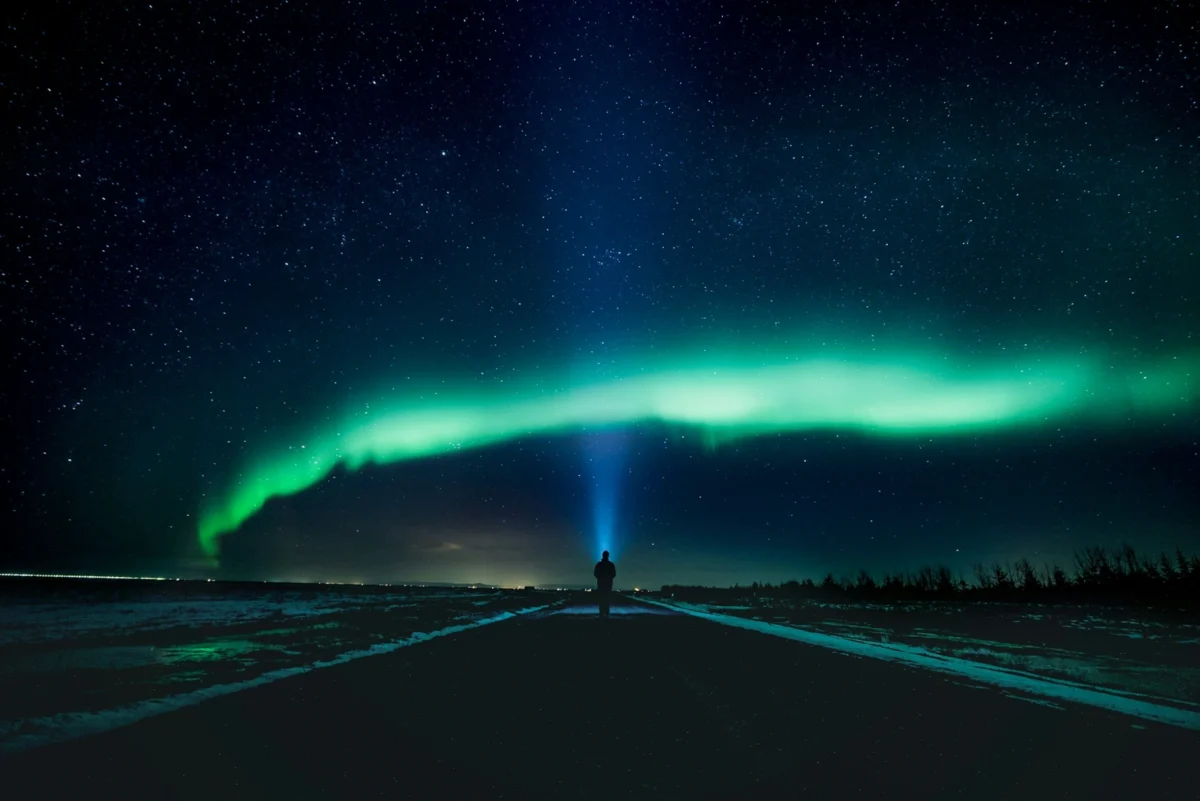
The northern and southern lights are caused by the Sun. Particles from the Sun meet gases in our air, and the gases glow. The lights are most often seen near the North and South Poles.
Two names for one show
NOAA calls these light shows auroras. Near the North Pole, people call it the aurora borealis, or northern lights. Near the South Pole, it is the aurora australis, or southern lights.
A night show with a daytime cause
Auroras are best seen at night. Even so, they start with the Sun. It sends us heat and light, plus other energy and tiny particles.
Most of that never reaches us. Earth’s magnetic field acts as a shield, and we do not notice it at all.
When the Sun gets stormy
The Sun does not send the same amount of energy all the time. A steady stream called the solar wind flows out all the time. Now and then, there are solar storms too.
In one kind of storm, called a coronal mass ejection, the Sun throws out a huge bubble of electrified gas. It can race through space at high speed.
Down the field lines
A solar storm may head our way. Some of its energy and particles then follow Earth’s magnetic field lines down at the poles. There they meet the gases in our atmosphere and set off the glow.
What makes the colors
Each gas gives its own colors. Oxygen glows green and red. Nitrogen glows blue and purple.
Lights on other planets
Earth is not alone. NOAA says a planet with an atmosphere and a magnetic field probably has auroras too. Scientists have seen them on Jupiter and Saturn.
The risky side of solar storms
The same storms can cause trouble. Their energy can damage power grids, communication systems and satellites in orbit. Astronauts on the International Space Station have to take care, and a spacewalk during a solar storm would be a bad idea.
NOAA’s GOES-R weather satellites watch the Sun for solar storms and give warnings. They also track Earth’s magnetic field and conditions in space. For another way our air plays with sunlight, read why the sky looks blue.