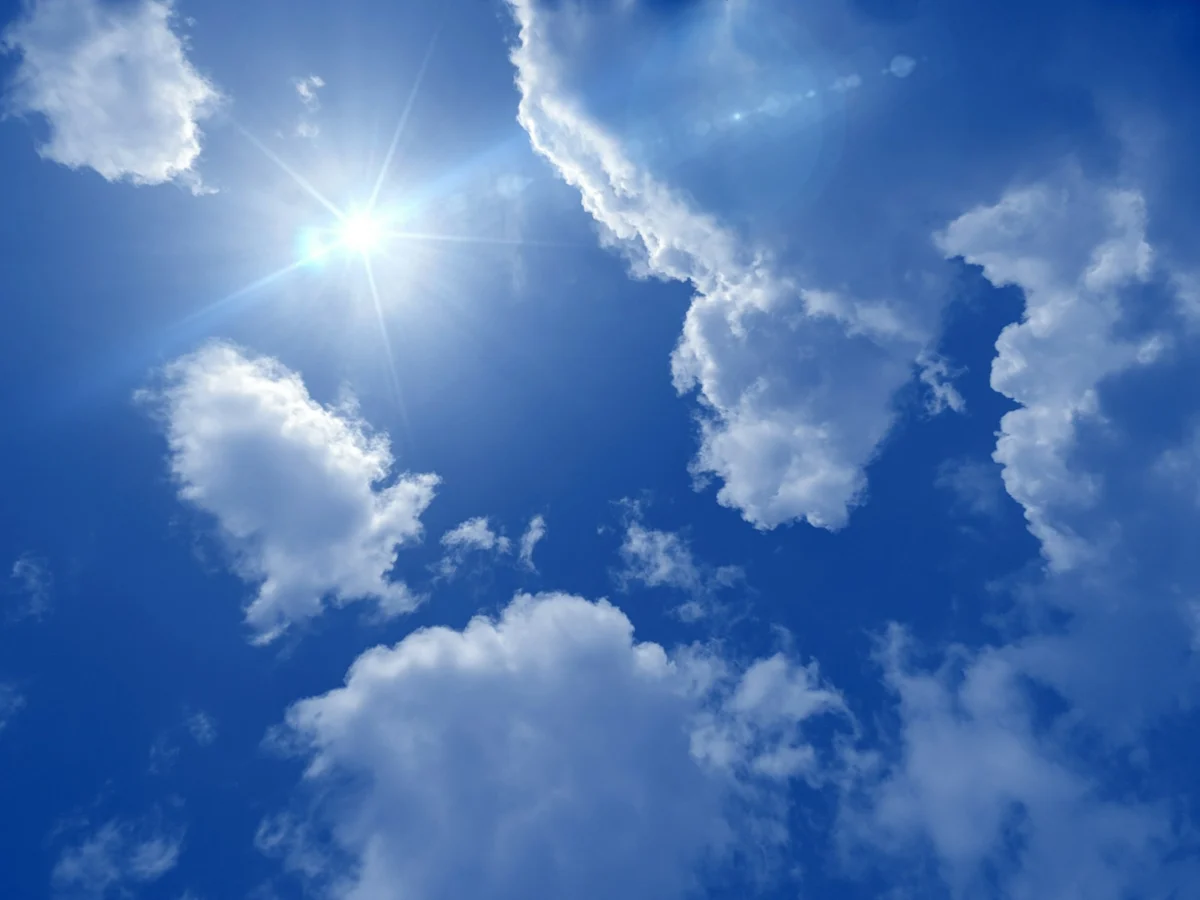
Sunlight looks white, but it holds every color of the rainbow. When it hits the air, blue light gets scattered the most. That scattered blue fills the sky.
White light, many colors
A prism splits white light into its colors. Raindrops do the same thing when the Sun lights them, which is why we see rainbows. NOAA says the white light from the Sun is really all those colors mixed together.
Short waves and long waves
Light travels in waves, and each color has its own wavelength. The longest waves we can see look red. The shortest look blue or violet.
These waves are tiny. A red wave is about 750 nanometers long, and a blue or violet wave is about 400. A nanometer is one-billionth of a meter. A human hair is about 50,000 nanometers thick.
What the air does to light
Light moves in a straight line until something gets in the way. A mirror can reflect it, a prism can bend it, and the gases in the air can scatter it.
When sunlight enters the air, most of the red, yellow and green light passes straight through. The blue and violet waves are just the right size to bounce off gas molecules. They get scattered in every direction, so blue reaches our eyes from all over the sky.
Where the violet goes
Violet light is scattered too, so why is the sky not violet? Some violet light is absorbed high in the atmosphere. Our eyes are also less sensitive to violet than to blue.
Paler near the horizon
Look low in the sky and the blue fades to pale blue or white. Light from there has crossed much more air. The blue has been scattered so many times that less of it reaches us. The ground also reflects and scatters light, which mixes the colors back toward white.
Red at sunset
When the Sun is low, its light passes through even more air. Even more blue is scattered away, so reds and yellows come straight through. Dust, pollution and water vapor can make the whole western sky glow.
A different sky on Mars
According to NASA Space Place, Mars has a thin atmosphere, mostly carbon dioxide, full of fine dust. NASA’s Mars Pathfinder lander showed an orange or reddish sky by day. At sunset, the sky around the Sun turned blue-gray, the opposite of Earth.
Why scientists care
Scattering matters for more than color. How sunlight is scattered, reflected or absorbed affects Earth’s climate. Satellites measure light at different wavelengths to learn about temperatures, water vapor and gases in the air. For how far light can travel, read a light-year is a distance, not a time.